Yet when one looks at the photographs of the garden created by the homeless, it strikes one that , for all their diversity of styles, these gardens speak os various other fundamental urges, beyond that of decoration and creative expression. One of these urges had to do with creating a state of peace in the midst of turbulence, a “still point of the turning world,” to borrow a phrase from T. S. Eliot.
A sacred place of peace, however crude it may be, is a distinctly human need, as opposed to shelter, which is a distinctly animal need. This distinction is so much so that where the latter is lacking, as it is for these unlikely gardens, the foemer becomes all the more urgent. Composure is a state of mind made possible by the structuring of one’s relation to one’s environment.
The gardens of the homeless which are in effect homeless gardens introduce from into an urban environment where it either didn’t exist or was not discernible as such. In so doing they give composure to a segment of the inarticulate environment in which they take their stand. Another urge or need that these gardens appear to respond to, or to arise from is so intrinsic that we are barely ever conscious of its abiding claims on us. When we are deprived of green, of plants, of trees,
most of us give into a demoralization of spirit which we usually blame on some psychological conditions, until one day we find ourselves in garden and feel the expression vanish as if by magic. In most of the homeless gardens of New York City the actual cultivation of plants is unfeasible, yet even so the compositions often seem to represent attempts to call arrangement of materials, an institution of colors, small pool of water, and a frequent presence of petals or leaves as well as of stuffed animals. On display here are various fantasy elements whose reference, at some basic level, seems to be the natural world.
It is this implicit or explicit reference to nature that fully justifies the use of word garden though in a “liberated” sense, to describe these synthetic constructions. In them we can see biophilia- a yearning for contact with nonhuman life-assuming uncanny representational forms.
Directions: Write an e-mail of about 100 words to a foreign teacher in your college inviting him/her to be a judge for the upcoming English speech contest. You should include the details you think necessary. You should write neatly on the ANSWER SHEET. Do not sign your own name at the end of the e-mail. Use “Li Ming” instead. Do not write the address. (10 points)
查看答案
Dear Professor Wang, Iam writing on behalf of our college to invite you to be a judge for the Englishspeech contest which will be held next week. We know that you are admired by all the students. As college students,we would like to improve our abilities in spoken English as well as writtenEnglish. We would be grateful if you could be the judge for this contest to beheld in Room 102, the Teaching Building on Saturday,June 4th, at 7p.m. We trust you will be disengaged and able to give us the pleasure of yourcompany. We are looking forward to seeing you. Yours sincerely, Li Ming
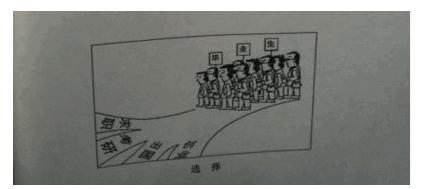
Directions: Write an essay of about 160 – 200 words based on the following drawing. In your essay, you should (1) describe the drawing briefly, (2) interpret its intended meaning, and (3) give your comments. You should write neatly on the ANSWER SHEET. (20 points)
查看答案
Emerging from the cartoon is an eye-catching scene that a mass ofgraduates are at a critical turning point on the way to the future. A varietyof choices, such as finding a job, going further education or abroad, and doingpioneering work, lie in front of them. The implication echoed by this cartoon can besummarized as a philosophic topic in our daily life:the success of a man is directly related to thechoice made by himself. Nevertheless, I cherish a belief that we can not tellwhether the selection is good or not, and as long as we adhere to our decisionsuccess will be realized step by step. Although making choice is essential tohelp determine the direction of our way, judged from the personal aspect, persistencefunctions as an indispensable driving force to keep up our spirit and to assistus to fulfill our study and work. However, some people, pacing up and down, are not industrious and tryto find a short-cut success. In fact, only those who are hard-working and braveenough to encounter obstacles of all sorts are most likely to reach the summitof success. It occurs to many that the most fundamental thing to success is making agood choice. But I recommend that graduates as well as all the citizens shouldstruggle to make their choice be a reality.