There are many occasions(场合) for giving gifts in modern industrialinzed societies;birthdays,naming ceremonies, weddings, anniversaries, New Year, It is common to give gifts on many of these celebrations in western cultures. In addition, special events, such as one’ s first day of school or graduation from university, often require gift fiving.
What is happening when we give gifts? Most important, we are exchanging gifts. If someone gives me a gift for my birthday, I know that I am usually expected to give one on his or her next birthday. A gift builds up or confirms a social oblingation(义务).
Gifts tighten personal relationships and provide a means of communication between loved ones. People say that a gift lets the recipient(接受者) know we are thinking of them, and that we want to make the person “feel special.”We want people to feel wanted, to feel part of our social or family group. We give presents to say “I’m sorry.”Sometimes it is difficult for us to find a present that someone will like. Sometimes we give things that we like or would frrl comfortable with. In all these cases, the gifts are sending out messages-often very expressive ones.
People tend to talk about presents in a fairly loving way. A woman whose mother had died years ago described the many gifts around her house.These were gifts that her mother had given her over the years:“I appreciate these, and they mean something to me,”the woman said,“because I remember the occasions they were given on, and that they were from my mother, and the relationship we’ve had.”The gifts remain and keep the relationship alive in mind. This woman felt the same way about the gifts she gave to others. She hoped that the recipients would look at here gifts in years to come and
Emotions(情感)like these suggest that a positive spirit still lies behind gift giving. They prove that the anthropologist Claude Levi-Strauss was wrong to say that modern western gift giving is highly wasteful. Studies in Canada and elsewhere have also shown that this is not the case. Each gift is unique even if so many are given.The emotional benefit for those who exchange gifts is the very reason for the tradition to continue.
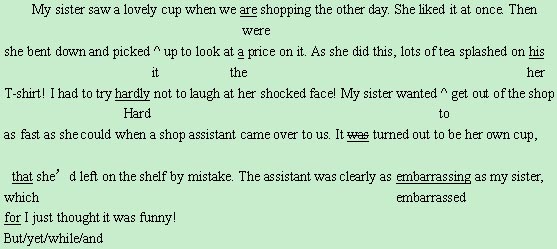
假定英语课上老师要求同桌之间交换修改作文,请你修改你同桌写的以下作文。文中共有10处语言错误,每句中最多有两处。错误涉及一个单词的增加、删除或修改。 增加:在缺词处加一个漏词符号(^),并在其下面写出该加的词。 删除:把多余的词用斜线(\)划掉。 修改:在错的词下划一横线( ),并在该词下面写出修改后的词。 注意:1 每处错误及修改均仅限一词; 2 只允许修改10处,多者(从第11处起)不计分。 My sister saw a lovely cup when we are shopping the other day. She liked it at once. Then she bent down and picked up to look at a price on it. As she did this, lots of tea splashed on his T-shirt! I had to try hardly not to laugh at her shocked face! My sister wanted get out of the shop as fast as she could when a shop assistant came over to us. It was turned out to be her own cup,that she’d left on the shelf by mistake. The assistant was clearly as embarrassing as my sister, for I just thought it was funny!
Dear Sure, I’m Li Hua, one of your students in China. It’s almost a month since you left us. We all miss you and are very grateful for what you did for us. We are busy as usual. We had an English speech contest the other day. I won the first prize! This again reminds me of all your kind help. Do you still remember the trees we planted together on the hill behind the school? Yesterday, we went there and watered them. The tree you planted yourself is growing well, and the whole class decided to name it Sue Wood. Will you come back to see Sue Wood? How is everything with you lately? We hope to know more about you and your American students. Hope to keep in close touch. All the best Li Hua