This picture book explores the life of a tree that has deep roots,long arms,and many children. She provides shelter for many animals and bears fruit. The author uses colorful, simple,yet detailed watercolor illustrations to convey her words. The charming pictures show the many aspects in the life of a tree down to the caterpillars that eat the leaves. It is good for pre-school children.
This charming picture book highlights the life of a garden,from planting seeds to harvesting. With the narrator as guide,the reader is led through a variety of free verse and occasionally rhymed poems that fill in the story of a garden and its inhabitants. The pictures. delightful watercolors in bright pastels,add to the whimsical feel of the poems. Young readers will certainly enjoy this fun and fanciful text.
This is a story from 1956 which introduces a little boy who likes to go fishing with a tree limb, a woman,and a pin. Although he never catches anything,on this particular day he finally does hook three big ones,but the little one gets away. The boy pulls them home in his wagon and his mother cooks them for supper. The swinging rhythms of the text and the good humor evident in the illustrations remain fun for the youngest readers.
This useful,attractive,oversize volume uses its height well,employing a tree metaphor to show the earth’s various kinds of life and how all living things. from bacteria to the largest mammals,are related. Each spread covers one branch of the animal kingdom. To make the enormity of species understandable. Strauss equates individual species(e. g. ,1 0,000 bacteria)with one leaf on the tree.
This is a story about how a grandfather teaches his eager granddaughter to catch speckled trout from the stream in springtime. After a whole day on the lake,only Grandpa is lucky. The next morning the young fisherman hurries to the dock alone,and soon she hooks the catch of a lifetime. Young readers will appreciate this story that celebrates the special bond between the older and younger generation,while brilliant watercolor illustrations capture the beauty of the natural world
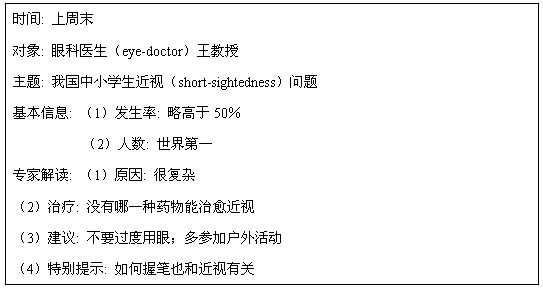
Last weekend, I had an interview with eye-doctor Professor Wang about our country primary and middle students’ short-sightedness. It is said that slightly more than 50% students, which ranks the No. 1 in the world, are short-sighted. Professor Wang said the reason of short-sightedness is complicated and three is still no cure for short-sightedness. He suggested that we should not overuse our eyes and do more outdoor exercises. What’s more, since the holding of pen has something to do with the short-sightedness, we need to pay attention to using the pen.
阅读下面的短文,然后按照要求写一篇150词左右的英语短文。 Jackie is perhaps the most easily annoyed koala(考拉)at the Featherdale Wildlife Park in southern Australia. All the koalas there are unhappy and complaining. You would be too if you were used to night activities and someone kept waking you up all day while you were trying to sleep it off. That’s right—sleep it off. The average koala is always half asleep because it feeds on the leaves of a special kind that makes it sleepy. The reason Jackie and her fellow koalas are repeatedly awoken from their deep sleep is so they can be hugged and photographed by tourists,who make the trips to Featherdale and an increasing number of other national parks for just that special experience. Whatever department in the Aussie government in charge of such things is now moving to make the practice illegal,which is understandable. How would you react,my friend,if you were trying to sleep off a dozen times and some round,furry creature smelling of grass kept waking you? * 考拉即树袋熊 [写作内容] 1、 以约30个词概括这段短文的内容; 2、 然后以约120个词就“该不该禁止游客和动物拍照”进行议论,内容包括: (1)人们在参观动物园时为什么喜欢和动物拍照; (2)假如你处在那些动物的处境,你会有什么反应; (3)你认为是否应该禁止游客和动物拍照。 [写作要求] 1、 在作文中可以使用自己亲身的经历或虚构的故事,也可以参照阅读材料的内容但不得直接引用原文中的句子; 2、 作文中不能出现真实姓名和学校名称。 [评分标准] 概括准确,语言规范,内容合适,篇章连贯。
查看答案
The passage narrates that koalas who are repeatedly awoken from their deep sleep are unhappy and complaining for tourists taking photos. The author appeals to us to be more kind to animals. The reasons why tourists like taking photos of the animals in the zoo perhaps vary from people to people. Some think it a happy reminder of their visit to the zoo or the animals, while others may consider it just sort of fun to have. But anyway they may not share the deep feelings of the animals. If I were in the same position as the animal in the zoo, my reaction would be very severe strongly against being photographed. No having peaceful surroundings to sleep, don’t you suffer restless and fidgets. No doubt we do and so do the animals. I think it necessary to ban tourists’ taking pictures with animals, making a comfortable environment for them to live and regarding them as our friends, so as to found harmonious relations with animals.